
Words to Delete from the Dictionary: 'Conservative'
And preferably also opposites like 'progressive', and certainly also the American 'liberal'...

(This is a translation of a rant essay that I posted earlier in Dutch)
A few days ago I heard a story on the radio news about a study done here in Belgium, in which men of the younger generations were called more ‘conservative’, because 1 in 5 men think that there can be a situation in which a man can hit a woman. The title of the accompanying video on social media was ‘Young men think more conservatively again: “The man must dominate women in many areas”’
What struck me, apart from the worrying trend of certain men (both in conservative religious and extreme right corners of society) to no longer believe in women’s rights, or the equal treatment of women as persons, is the use of that word ‘more conservative’ for that. So the man who has to dominate the woman in many areas, or even hit her, is now ‘conservative’ according to a Flemish state broadcast?
And then I start asking questions. Why use that word exactly? What do we conserve here? Are we even conserving something that has existed here in this way? And if we let our thoughts go that way, don’t we better just get rid of the word? I once, a long time ago on my old blog, argued that words like conservative, but also ‘progressive’ and certainly also the American opposite ‘liberal’ are essentially meaningless, but even apart from that, it is also just dangerous territory if we are going to accept that the state broadcast calls beating your wife conservative or hints that it is. In this way, very dangerous ideologies are validated that should never be normalised.
The problem here is also that we are left with words that are constantly used in different ways, and so they can be very easily abused to manipulate. The words mentioned are not only empty boxes that can be provided with all kinds of ideological content, depending on how the wind turns, and sometimes they seem mainly used as a propaganda tool. Often with American influence here too. As it is sometimes said “When it pours in America, it drips here in Belgium”, and things are happening on the other side of the ocean with those labels that we can use here as much as a toothache.
American conditions like Trumpism (which is in fact a complete reversal of all traditional values, but who cares if even truth doesn’t matter anymore) called ‘conservative’, as well as a transhumanist of the type who wants to implant microchips into the human brain and use AI to create a completely new world in his own image and likeness in which human work is ‘obsolete’, with at least 4 women and at least 14 children, partly using IVF techniques to have only sons. We have ended up completely at the opposite of any set of traditional values here. (If you don’t realize who I’m talking about, click on the links)
But back to the word ‘conservative’, and the question of whether we can still use it in a healthy way. The two questions we can ask to start are: what does the word mean, and how is it used. And as we have already seen, both questions could give a completely different answer, especially if we allow the aforementioned American influence for example...
The basic meaning as I have always understood the word is that ‘conservative’ actually just means wanting to conserve things. A dictionary search via Google confirms that idea.
• averse to change or innovation and holding traditional values.
We have a simple definition, but one that can be very context-relative: ultimately a conservative ideology is one that wants to preserve a given culture, and that wants to protect the good of the past. Which in itself is a noble goal, of course.
But that is of course too simple too. If we forget all the American baggage for a moment, and dig a little deeper, we see that ‘conservative’, also as opposed to ‘progressive’, has a long history in modernist thinking, often with other connotations attached to it. Think of Chesterton’s famous quote from 1924, about the state of modern ideology:
“The whole modern world has divided itself into Conservatives and Progressives. The business of Progressives is to go on making mistakes. The business of Conservatives is to prevent mistakes from being corrected.”
Chesterton is very cynical here. Progressives, who improve the situation, make the mistakes, and if they are well established in a culture, those are ultimately defended by ‘conservatives’ who now want to maintain the tradition that was once formed. Which is indeed often the case, everything that is now defended as conservative must have been new at some point... Usually you need less than one lifetime to introduce something within just one generation and make it traditional.
(Funnily enough, rebellious music genres like punk are often the fastest in forming and defining the genre, and after a few years boundaries were formed very quickly, and it was a very conservative genre in terms of form and themes that resisted change. Most types of rock, metal, hip-hop and house have a very conservative slant after a few years with very strongly guarded boundaries and gatekeepers...)
Chesterton continues, by the way, in the direction I just indicated, but more cynical:
“Even when the revolutionist might himself repent of his revolution, the traditionalist is already defending it as part of his tradition. Thus we have two great types -- the advanced person who rushes us into ruin, and the retrospective person who admires the ruins. He admires them especially by moonlight, not to say moonshine. Each new blunder of the progressive or prig instantly becomes a legend of immemorial antiquity for the snob. This is called the balance, or mutual check, in our Constitution.”
If we leave the cynicism behind us for a moment, and assume that culture is not only formed by the accumulation of cumulative errors that are cemented into traditions, the same principle still remains valid in a more neutral way. Innovation very quickly gets formed into a new tradition, which at some point will be defended by conservative traditionalists. And so we are left with an eternal cultural evolution and cycle of dialectical processes. And everything from the past can ultimately become the object of nostalgia and conservative defence. And then the glitch can begin, and a new problem enters, and we also get the factor of poor memory, or false readings of the past. If it even seems to have been present in that culture in earlier times, as we will look at later.
But for now, it is important to consider what is seen as ‘conservative’ in one culture, tradition or group that will not be at all on the other side of the street, or from the border or from the sea.
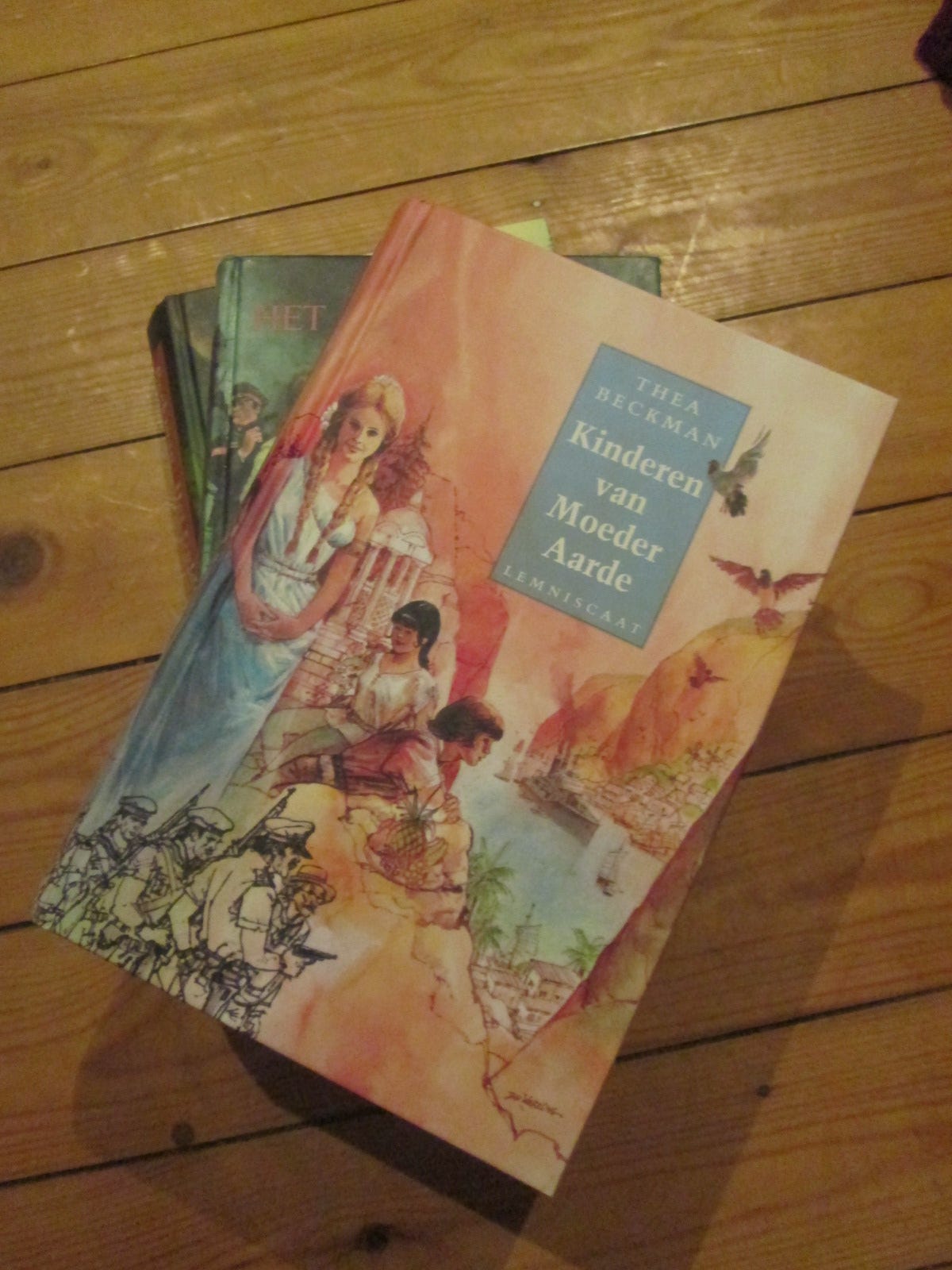
And then I remember one of the first times I became aware of the word, in a children’s book. The word ‘conservative’ is used in a negative way by Professor Kunz in Thea Beckman’s post-apocalyptic future novel ‘Children of Mother Earth’. He comes from the Great Badener Empire, an industrial patriarchal European culture that wants to colonize the world and has rediscovered classical modernist ideas of progress (and caused ecological disasters in the process). The Thulenes, who live in a temperate Greenland and have a matriarchal, violence-averse much more ecological culture, are not interested in that progress, which frustrates him immensely
:
“The women in the palace are polite to me, but otherwise they remain as closed off as a pot. I tried to interest the Konega in the use of electricity and explained to her that you can generate it with hydropower, with windmills, with all the fuel that is available. But as soon as it dawned on her that a network of electrical wires would have to be stretched across the land to direct the power from the plant to factories and homes, she began to moan about landscape decay and things like that. I don’t believe you will find such stupid, conservative and sentimental women anywhere in the world as right here in Thule.’
Interesting how here, in a children’s book, the word conservative is deconstructed to its cultural-relative essence, in which Kunz sees ecologism (in combination with matriarchal non-violence) as a kind of sentimental conservatism that stands in the way of progress such as his own culture. Ignoring that this progress means a heavy dictatorship and ecological destruction in practice also... That side of the story is also simply based on a very common traditional European interpretation of ‘progress’ from previous centuries: technological and industrial progress, in which nature has to lose. Anything that goes against that is conservative in a pejorative sense, and sentimental and even stupid, at least according to Professor Kunz.
But not only are his words like “conservative” and “progressive” completely relative and context-bound in content, and even depend on an ideological preference of what older things in a culture one wants to keep or not, there is an even bigger problem that I already mentioned, and that is that of false cultural memories and return to a past that never was.
The patriarchal ideas of the manosphere that we started with are not always ‘conservative’ in the sense that they want to preserve something existing, they even often want to go back to an imagined past, some of which never existed. A lot of patriarchal types just invent a glorious past on the spot that is much worse than the past itself was, and then make it normative, no matter how unreal and in practice ineffective it is.
Think, for example, of the ‘Flat Earth’ thing. I would never have believed it when I was younger, but today there are corners of the internet teeming with “Flat Earth” proponents who would have us believe that this is a return to some past truth from a time we not lied to yet by the U.S. government, or NASA, or whatever. Some even say that it is always the only correct way to read the Bible, and pretend that it makes perfect sense to go back to the truths of the past.
In reality, hardly anyone has believed in a Flat Earth since Greek times, not even in the Middle Ages. (For those who would like to read more, this article from history for atheists is very informative) So the Flat Earthers are going back to a history that never existed, something that is painfully common among conservative groups if you look closely at the myths about the past that they propagate. The American Founding Fathers are being rewritten as Evangelical Christians, although they were deists at best. (The false myth-making and falsification of history among American Christian Nationalists is extreme, by the way)
The Battle of the Golden Spurs of 1302 is called a great victory here in Flanders, but it’s often swept under the carpet how small the effect actually was in the long run. The fact that at Pevelenberg (1304) the Flemings were defeated again, and at the Peace of Athis-sur-Orge (1305) they had to pay astronomical compensation and had to cede a series of cities to France is completely ignored...
Or take the drunk old Stalinist who tries to convince his listeners in the café Het Volkshuis that there were no deaths in Soviet communism, and that we should try it again. Again in this example it’s clear he’s just as stuck in preserving his tradition as any ‘conservative’ could be.
And these are not even the big exceptions; in some circles it is really a pattern. A lot of ‘conservatism’, especially on the internet today, falls into this kind of trap of trying to preserve something that never even existed. A lot of manipulation, disinformation and propaganda, no facts, and no actual roots in an older culture. Think also of the ‘tradwives’ linked to the manosphere stuff mentioned earlier, the sort who parade in flawless clothing to put up an act in front of the camera, but who would not survive a day in a real agrarian society where women not only have to be eye candy but also have to have muscles and work... False history and people who want to return to it are everywhere…
But if we leave all false history and abuse aside for a moment, and assume that in a healthy form of conservatism at least something is preserved that exists in a culture and is ‘seen as good’. Even then, we have all sort of opposing sides that can all be defended. From older versions of our culture there are many often contradictory ideas to be extracted, and very diverse ideologies and systems that could be preserved, and that we cannot all preserve at the same time.
And we certainly shouldn’t go along with people who project their own history onto the rest of the world, and onto wider systems, as Americans often do with their so-called conservatism, which is a hotchpotch of authoritarian religious thinking, extreme market capitalism and very culture-specific ideas about ‘freedom’, all of it extremely culturally specific and none of them very old in historical terms, let alone connected to older Christian tradition. (The Pope would be a far better point of reference for Christian conservatism here for example. Caring for the poor and the vulnerable is much older in Christianity and much more worthy of conserving than extreme market capitalism and glorification of competition and the like.)
So until we know what we want to preserve and can articulate that specifically, and what really comes from our past and what doesn’t, I suggest that we better erase the word ‘conservative’ as well as all of its possible opposites from our dictionary. Now it is mainly misused for propaganda purposes, and it is an emotional word to which everyone gives their own meaning, like a kind of Rorschach blot.
And that is dangerous when we reduce everything to ‘vibes’ and vague mythmaking without much real content and add the false history as well. Then the word is just a Newspeak propaganda tool that can be reused in many different ways.
If going back to the research I started with, with people claiming that the most toxic manosphere shit that never even existed that way has existed here in our past is ‘conservative’, we see why that’s a big deal. Men who oppress women, and also make themselves the worst version of themselves, pretend to go back to a better old time that only exists in their fantasy.
And yes, before anyone says something, yes of course, the same argument can be made with ‘progressive’, a word that also only means that you are into progress, that you want things to change. There is a naïve tendency to link ‘progressive’ only to socialist or ecological ideals today, but that is not necessary at all, there are many more ways in which you can want to change society. I think of another story I read as a child, the Narnia story The Voyage of the Dawn Treader, when Caspian, who himself has just been almost sold as a slave, argues with the governor about the slave trade, which he said would bring prosperity and progress.
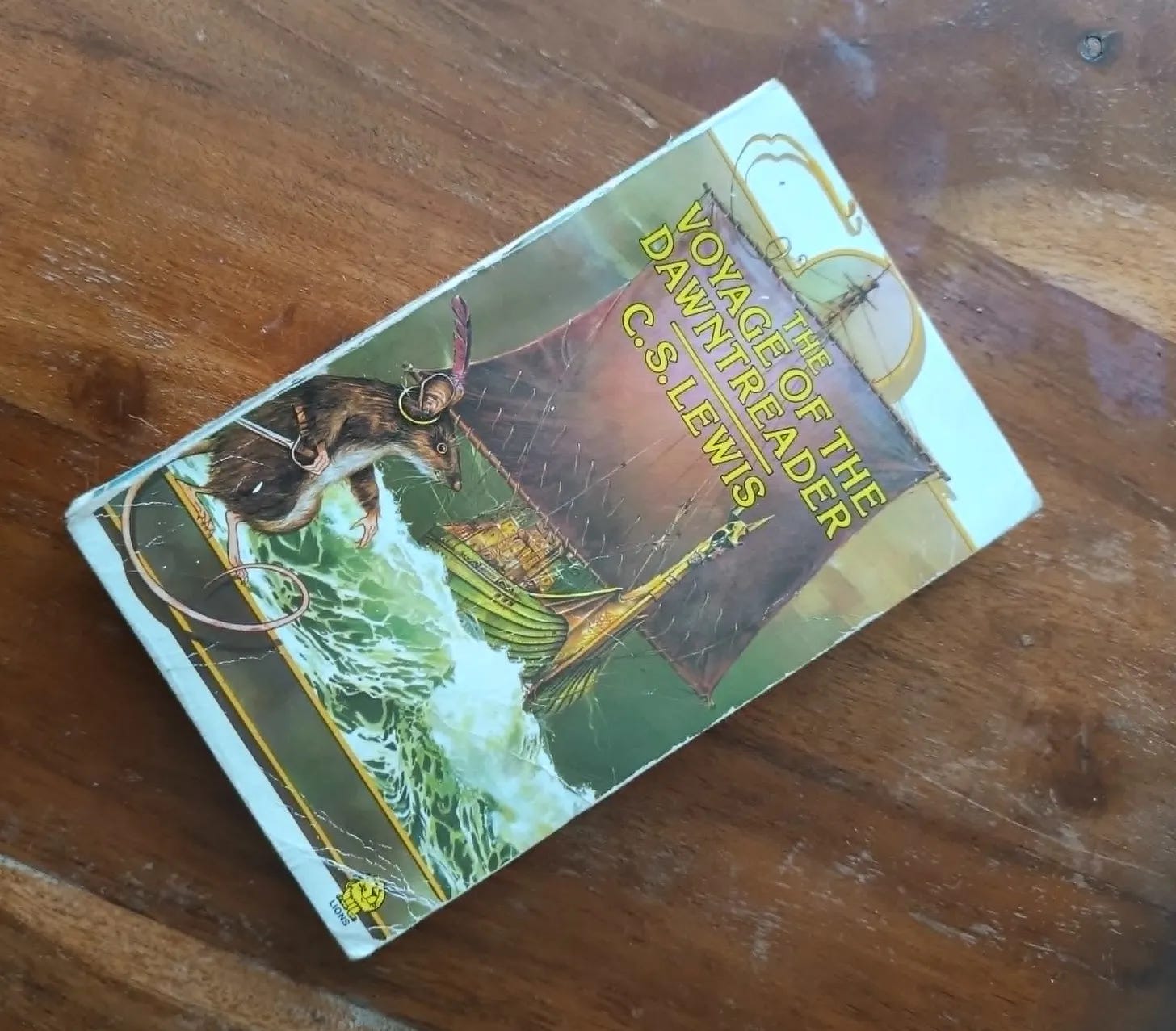
“Do you have no idea of progress, of development?”
“I have seen them both in an egg,” said Caspian. “We call it ‘Going Bad’ in Narnia”
Technological progress and the conquest of humans over nature were once the basis of liberal thinking about progress, and in that way our aforementioned American multibillionaire who wants to implant chips in human brains, control culture through AI, and who has very new views on relationships and parenting is mainly progressive, but not in a healthy way. Just as the factory bosses of the time of our Flemish priest Daens were beacons of ‘progress’ too...
Progress can go in all kinds of directions. Not all progress is going in the right direction, not everything we keep is worth keeping. Today’s Americanized ideas of the “Left” and “Right” give many naïve connections that should not exist. Of course, there are things we need to conserve (starting with nature, healthy parts of our culture and heritage, healthy values, and the healthy living conditions of every human being) and things where we need to bring about change and progress (if there is injustice, unhealthy relationships, destructive systems, ignorance, etc...), but the line between the mythologized versions of ‘conservative’ and ‘progressive’ is certainly not going to help anyone here.
(I’m not even going to say much about the American ‘liberal’ as the opposite of ‘conservative’, which is used in America in a way that is completely separate from the original meaning of the word and how it is used in the rest of the world that I would need half a book to interpret that, which I don’t feel like doing at all. It’s funny that American ‘conservatives’ adhere to an extremist version of (neo)liberalism and then pretend that everything that is ‘liberal’ is bad. You can’t even parody that...)
I think I’ve written enough by now, and that for those who haven’t dropped out yet, I’ve made my point why the word ‘conservative’ is not only vague today, but can also very easily be used manipulatively from both sides, and is better put in the freezer for a long time...
What do you think?
Bram